




DGB-D 디지보드, 디지털 증폭기
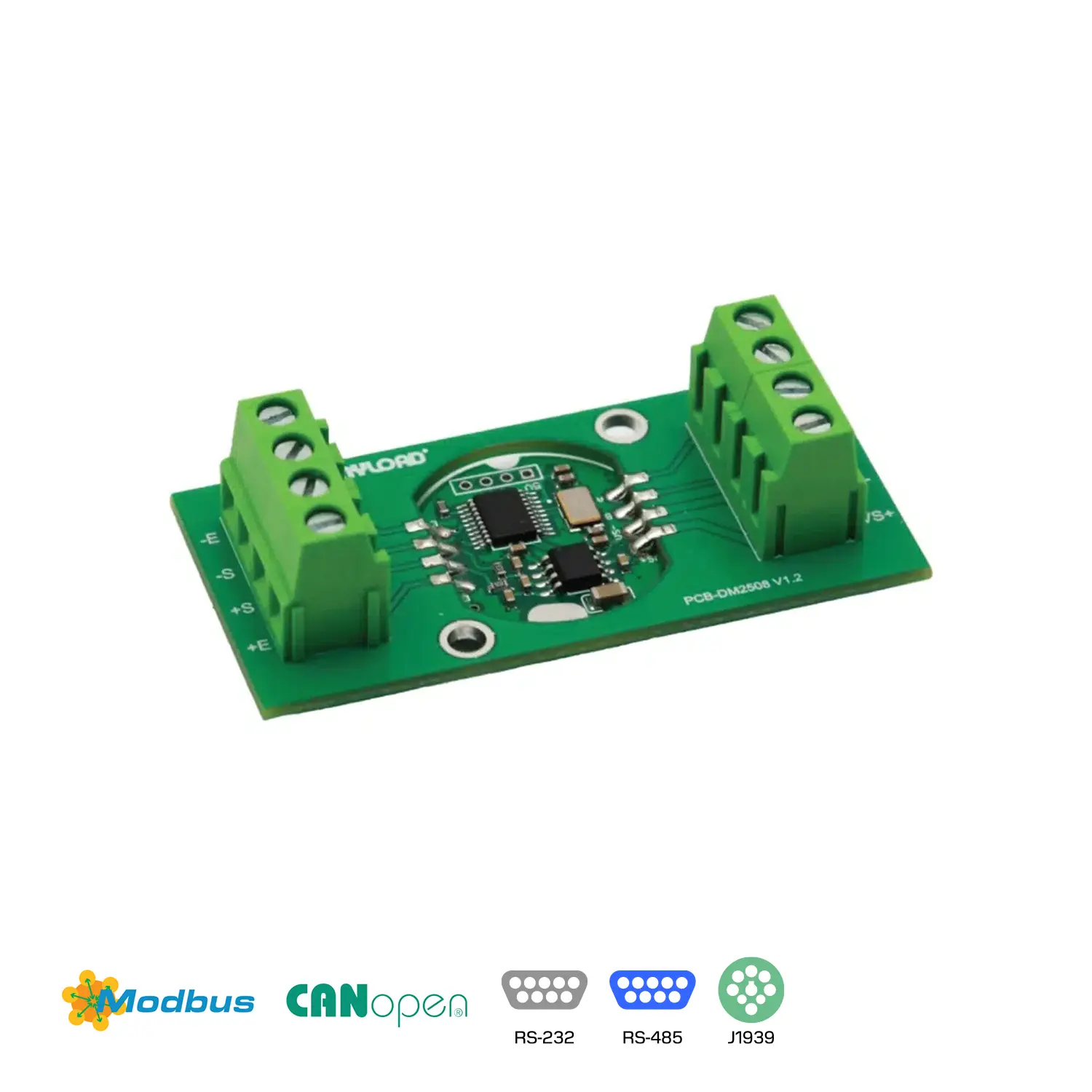
The ANYLOAD DGB-D Digital Load Cell Amplifier Board is a compact PCB-based signal conditioning module designed for embedded integration into OEM equipment, control panels, and custom electronics assemblies. It converts analog strain gauge signals into digital outputs including CAN J1939, CANopen, Modbus, and RS-232/RS-485, enabling seamless communication with ECUs, PLCs, and industrial control systems. Built with a 24-bit A/D converter and high-speed processor, the board delivers stable, high-resolution measurement with low non-linearity and high full-scale accuracy, making it suitable for both dynamic and static force measurement applications.
Designed for flexibility in embedded systems, the amplifier board accepts 0.5–3.9 mV/V strain gauge inputs, supporting a wide range of sensors including load cells, torque transducers, force sensors, and other Wheatstone bridge-based devices. Its 9–24 VDC operating range allows integration into mobile equipment and industrial electronics. Advanced onboard processing includes configurable sampling rates (10–320 SPS), digital FIR filtering, zero tracking, stability detection, and multi-point calibration (2–9 points), allowing engineers to optimize performance for vibration-heavy environments or high-speed measurement requirements.
As a PCB-level solution, the DGB-D is intended for direct integration into enclosures, control cabinets, or embedded systems, providing a streamlined interface between sensors and digital control architecture. In CAN-based implementations, it supports SAE J1939 communication including address claiming, broadcast messaging, and parameter read/write via PGNs, enabling remote configuration and diagnostics across distributed systems. Across all supported protocols, the board reduces reliance on analog signal conditioning and simplifies wiring in complex machine designs.
Software & Configuration
ANYLOAD provides PC-based software tools for setup, calibration, and data acquisition. Engineers can configure filtering, sampling rate, calibration parameters, and offsets while monitoring real-time output and logging data for validation and system commissioning. Communication is supported via the selected interface (e.g., CAN via USB adapter, RS-485, or serial connection), making the board suitable for both development and production environments.
특징
- One input port can connect directly to 1 x 350 Ω load cell or max 4 x 350 Ω (or higher resistance) load cells through a junction box
- 24 bit A/D Converter, high speed processor
- Internal digital filter and strong anti-interference ability
- Can perform up to 9 point linear calibration
- Applied to all kinds of strain gauge bridge-type load cell, such as tension, compression, torque and so on
- 역극성 보호
- The chip is 24.6 mm in diameter and can be embedded within load cells, making the load cells have built-in analog signal amplification
- 보정에는 소프트웨어가 사용됩니다.
- DGB-D Chips can be integrated into load cells for built-in digital signal conditioning/transmission (special order required)
사양
| 로드셀 유형 | All strain gauge type |
|---|---|
| 전원 공급 장치 | 9 – 24 V DC |
| 전력 소비량 | 0.36 W @ 12 V DC |
| 입력 범위 | -3.9 to +3.9 mV/V |
| 작동 온도 | -22 °F – 122 °F / -30 °C – 50 °C |
| Excitation Voltage To Load Cell | 5V DC |
| 비선형성 | ≤ 0.01% |
| Temperature Coefficient | ≤ 100 ppm / °C |
| 출력 신호 | RS-232 (DGB-DM2507B) RS-485 (DGB-DM2508B) CAN Bus (DGB-DC2508B) CAN Bus, CAN J1939 (DGB-DC2508-J1939B) |

애플리케이션
- Embedded weighing systems in agricultural and construction equipment
- On-board vehicle weighing and load monitoring systems
- Industrial automation and PLC-based control systems
- Custom electronics and instrumentation platforms
- Force, torque, and strain measurement systems requiring digital output
Integration Notes
- Intended for installation inside customer enclosures or control systems (non-IP rated PCB)
- Requires appropriate environmental protection and power conditioning
- Compatible with standard strain gauge load cells and mV/V sensors
- Designed for direct communication with PLCs, ECUs, and embedded controllers
- Ideal for OEMs developing integrated measurement systems with digital communication
 English
  Korean
  French
  Spanish