

Industrial Tank, Silo & Hopper Weighing Solutions | Anyload
Retrofitting an existing vessel into a certified weighing system once meant invasive sensors, process downtime, and instrumentation that began to degrade the moment it contacted the material. Anyload compression 및 tension weigh modules eliminate all three by mounting completely external to the structure, so no component ever enters the process zone.
Available in configurations for vessels ranging from 50 lbs to 200,000 lbs, these modules convert tanks, hoppers, silos, and mixers into NTEP-certified scales with custody-transfer accuracy. That means no sensor fouling from high-viscosity fluids, no corrosion failures, no freeze damage, and no read errors caused by foaming or material bridging inside the vessel.
Compression Weigh Modules for Tank & Silo Scales
Convert Existing Tanks and Silos to Certified Scales
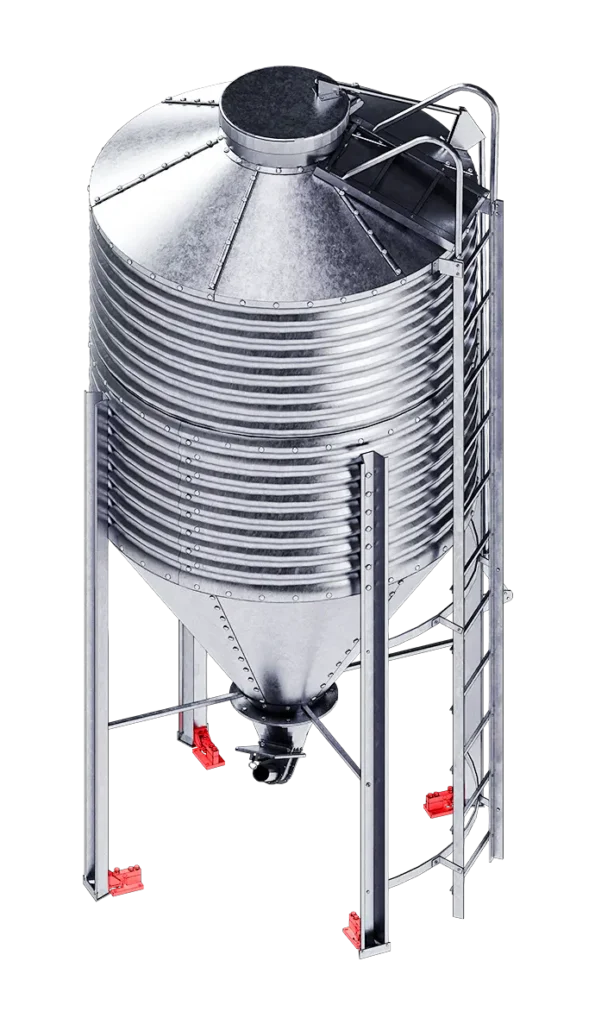
Most industrial vessels, such as storage tanks, process silos, batch hoppers, and mixing vessels, rest on three or four structural legs. That existing support geometry is exactly what Anyload’s compression weigh modules are designed for. A range of bottom-mount assemblies can be inserted beneath each structural leg to convert the vessel into a fully certified weighing system, without modifying the vessel itself.
Thermal Expansion and Reading Accuracy
A steel tank holding hot liquid or operating in an outdoor environment expands and contracts with temperature. On a rigidly mounted system, that movement introduces horizontal side-load forces into the load cell. The cell was not designed to measure these forces, which corrupt weight readings without any visible indication that something is wrong. Anyload compression weigh modules address this through a rocker pin or floating-mount design, allowing controlled lateral movement while the load cell precisely bears vertical load. The result is accurate weight data regardless of operating temperature or ambient conditions.
Three-Point Vs Four-Point Mounting
Three-point mounting is inherently self-leveling. All three points share the load predictably regardless of foundation settling or thermal movement. Four-point mounting offers greater structural stability for large-diameter vessels but requires careful shimming and periodic re-leveling to ensure equal load distribution across all four modules. For new installations, three-point mounting is generally preferred where vessel geometry allows. For retrofits, the existing structure determines the approach. Anyload offers weigh module kits configured for both, with hardware matched to the mounting geometry.
Tension & Suspended Weigh Modules for Hanging Vessel Scales
When to Choose Suspended Vessel Weighing & How to Manage Lateral Movement
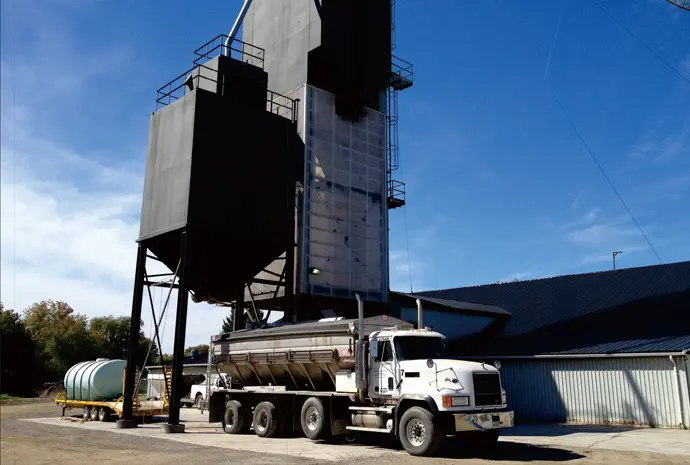
Where an overhead structure already exists, such as a mezzanine, structural beam, or process frame, suspending the vessel is often the faster, cleaner installation option.
Anyload’s tension weigh modules are designed for exactly this configuration: calibrated assemblies that hang the vessel from an existing overhead structure while delivering accuracy comparable to compression systems at equivalent capacities.
This configuration is particularly well-suited when floor space beneath the vessel must remain clear for personnel, forklifts, or discharge equipment; when the vessel is small enough that suspension hardware is lighter and less costly than a full compression support frame; or when an existing overhead structure can bear the load without modification.
Managing Lateral Movement
A hanging vessel behaves as a pendulum. Process vibration, filling impact, or agitator torque can introduce lateral movement, affecting reading stability. Properly designed suspension systems incorporate guide rods or lateral restraints to control movement without transmitting side-load into the load cells, following the same principle as thermal expansion management in compression systems. Applications involving significant agitation, high fill-rate impact loading, or external vibration sources require this to be engineered upfront rather than addressed after installation. Contact our engineering team to review your specific application parameters before specifying.
Washdown, Cleanroom & Hygienic Tank Weighing
Matching IP Rating & Material Specification to Your Cleaning and Sanitation Protocol

Weighing systems in food, pharmaceutical, beverage, and chemical processes must withstand cleaning as reliably as they perform in production.
Washdown Environments
Meat processing, dairy, brewing, and similar industries expose instrumentation to high-pressure hot water, caustic cleaning agents, and steam. The governing standard is the IP rating: IP67 covers temporary immersion, IP68 covers continuous submersion, and IP69K covers high-pressure, high-temperature washdown spray at close range—the standard required in many food production environments. The appropriate IP rating is determined by the cleaning protocol, not the production environment alone.
Anyload’s stainless steel weigh modules are engineered to meet these challenges across a range of capacities. The 363TSM1 ThinWeigh® 및 MK4-363TSM1 kits feature IP68/IP69K hermetic seals in 17-4PH stainless steel, making them ideal for direct high-pressure spray-down. The 563RSM5 및 MK4-563RSM5 kits are also IP68/IP69K certified and are a reliable choice for food and chemical processing lines at lower capacities (up to 500 kg). For applications where IP68 immersion protection is sufficient, the 563YSM3-02, 102BSM5및 102ESM2 offer stainless steel, welded-sealed construction across a wide range of medium to heavy capacities.
Hygienic and Sanitary Environments
Pharmaceutical, biotech, and food ingredient applications require load cell and mounting hardware surfaces to be free of crevices, threads, or recesses where product can accumulate. 3-A Sanitary Standards 및 NSF certifications establish these geometric and material requirements. Electropolished 316L stainless steel is the preferred material specification for the most stringent applications.
Where process requirements permit high-grade stainless steel construction without full 3-A geometry, the 363TSM1 및 102ESM2 utilize 17-4PH precipitation-hardened stainless steel with hermetically welded seals—eliminating exposed threads and gaps on wetted surfaces. Always confirm surface finish and material compatibility with your specific sanitary protocol before specifying.
Cleanroom Environments
Cleanroom installations introduce outgassing and particulate requirements that standard industrial load cells may not meet. Coatings and potting compounds used in general-purpose cells can be incompatible with ISO Class 5 and above classifications. Compatibility should be confirmed against the specific cleanroom classification before specifying.
CIP/SIP compatibility
Clean-in-place (CIP) and sterilize-in-place (SIP) systems circulate hot water, steam, and caustic or acidic cleaning agents through process equipment—eliminating the need for disassembly. Load cells and mounting hardware in contact with or adjacent to CIP/SIP circuits must withstand thermal cycling, chemical exposure, and transient pressure surges. Stainless steel welded-sealed construction is the baseline requirement, and gasket and O-ring materials must be verified for compatibility with the specific cleaning chemistry in use.
그리고 563RSM5, MK4-563RSM5및 363TSM1 are frequently specified in food and beverage CIP circuits for their IP68/IP69K ratings and fully sealed stainless steel construction. Always verify O-ring compound compatibility with your cleaning agent concentrations and temperatures before final specification.
Outdoor, Corrosive & High-Temperature Tank Installations
Specifying for Wind Load, Corrosive Exposure & Thermal Expansion in Tank Weighing
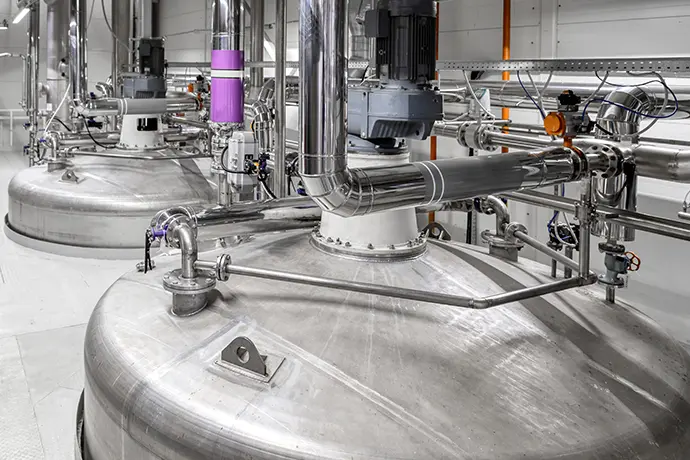
Outdoor bulk storage, chemical processing, refinery applications, and high-temperature reactors impose conditions that go well beyond the rated limits of standard industrial load cells. Correct specification in these environments starts with understanding the forces and exposures involved, not just the vessel capacity. See our 화학 탱크 계량 및 벌크 공급 탱크 계량 case studies for real-world examples.
Wind and Seismic Loading
An outdoor tank presents a large surface area to the wind. In high-wind or seismic zones, weigh modules must handle not only the downward weight of the vessel and its contents, but also uplift and lateral forces that act against the load cell’s rated direction of force. Check rods and safety restraints provide the engineering solution — mechanical stops that limit vessel movement to a safe range and prevent uplift without transmitting force through the load cell during normal operation. In seismic-zone installations, these provisions are a design requirement, not an option.
For high-capacity outdoor vessels, the 276EHM1 (alloy steel, 25–100t) and 102DHM3 (alloy steel, 5–250Klb) both incorporate anti-lifting protection and lateral stops, making them well-suited to the multi-directional loading imposed by wind and seismic events. The 363TSM1 ThinWeigh® provides uplift protection up to 50% of its rated capacity in its hermetically sealed 17-4PH stainless steel construction, making it a practical choice for outdoor installations where corrosion resistance is also required.
Corrosive Environments
Chemical plants, wastewater facilities, fertilizer storage, and marine installations expose instrumentation to acids, alkalis, hydrogen sulfide, salt spray, and chlorinated atmospheres. Standard carbon steel hardware degrades rapidly in these conditions, and painted surfaces offer limited protection over time. The specification checklist for corrosive installations includes: load cell housing material (304 SS minimum, 316 SS preferred, Hastelloy for severe service); hermetic sealing that is welded rather than potted; cable entry sealed to the same IP standard as the cell body; and mounting hardware in a compatible material to prevent galvanic corrosion between dissimilar metals.
Anyload’s stainless steel weigh modules address these requirements across a range of capacities. The 363TSM1 is built from 17-4PH precipitation-hardened stainless steel with an IP68/IP69K hermetically welded seal, providing the combination of corrosion resistance and ingress protection demanded in chemical and marine environments. For mid-range capacities, the 563YSM3 uses 304 stainless steel construction with a rocker pin design and lateral stops. The 102BSM5 extends stainless steel, IP68-rated protection to heavy capacities (50–75Klb), covering large outdoor bulk storage tanks in corrosive service. Confirm the compatibility of the hardware and cable gland materials with your specific chemical environment before specifying.
High-Temperature Process Zones
Load cells carry a rated temperature effect on output, typically expressed as a percentage of full scale per degree, which compounds in elevated-temperature environments. For example, a load cell rated at 0.01% of full scale per 10°C (a typical value for standard industrial cells) and installed close to a high-temperature vessel surface will produce measurable output drift across a production shift. Thermal isolation feet, heat shields, and load cells rated for elevated temperature service are available solutions. The vessel’s surface temperature at operating conditions is the starting point for selecting the appropriate approach. The 102DHM3 is specifically designed with a sliding pin mechanism that compensates for thermal expansion and contraction of the vessel, reducing mechanical stress on the load cell and associated output error across temperature cycles. This makes it a practical choice for high-temperature reactor and process vessel applications where the vessel and supporting steelwork undergo significant dimensional change between cold and operating conditions. Contact our engineering team with your operating temperature data for a specific recommendation.
Installation & Calibration
Foundation Rigidity, Dead Load Sizing & Traceable Calibration for Tank Scale Systems
A technically correct weigh module specification can still produce a poor-performing system if the installation is not executed properly. These are the factors most commonly responsible for field performance falling short of specification. For dimensional drawings, wiring diagrams, and installation procedures, the weigh module manuals and drawings library covers the full Anyload range. The troubleshooting guide addresses the most common field issues by symptom.
Foundation and Frame Rigidity
Summing and Junction Boxes
In a multi-module system, signals from each load cell must be summed accurately to produce a single weight reading. Anyload’s junction boxes are designed to match the weigh module range and are available in both analog trim-pot and sealed configurations, depending on the installation environment. For applications where long-term drift or maintenance access is a concern, digital summing transmits each cell’s signal individually, sums them in software, and can automatically flag discrepancies between cells.
Calibration Method
Legal-for-trade applications require traceable calibration. For large vessels where placing physical test weights is impractical, substitution calibration using a certified hydraulic or electronic reference system is standard practice. The applicable weights and measures authority for the installation jurisdiction determines which calibration methods are accepted; this should be confirmed before installation, not after. See NTEP 및 캐나다 측정 certification details for North American applications.
Dead Load and Live Load Management
The vessel itself, including the steel structure, insulation, piping connections, and agitators, contributes load to the weigh modules before any product enters. This dead load consumes capacity and affects resolution. A system sized on product capacity alone may produce insufficient resolution at low fill levels once dead load is accounted for. Modules should be sized based on total loaded weight, with the minimum product fill resolution confirmed against application requirements.
Load Cell Creep, Hysteresis & Temperature Coefficient in Tank Weighing Applications
How These Specifications Affect NTEP Recalibration Intervals
A weigh module’s published accuracy specification describes its performance at the time of calibration under controlled conditions. However, long-term accuracy, which refers to how the system performs after extended periods of thermal cycling, vibration, cleaning cycles, and foundation movement, is the figure that determines inventory control reliability, custody transfer validity, and ongoing compliance with certification requirements.
The load cell parameters that govern long-term accuracy are:
- Creep: output drift under sustained load, expressed as a percentage of rated output over a defined time period. Relevant for systems that hold a static load for extended periods between readings.
- Hysteresis: the difference in output when approaching a given weight from above versus below. Relevant for batch systems that repeatedly fill and empty across a production shift.
- Temperature coefficient: output drift per degree of temperature change. Relevant for any outdoor installation or process-adjacent application where ambient temperature varies.
- Zero return: the cell’s ability to return to its original zero output after the load is removed. A direct indicator of long-term calibration stability.
These are not academic specifications. They are the difference between a system that holds its NTEP certification through annual inspection and one that requires recalibration every six months. OIML test reports and NTEP certificates for Anyload weigh modules are available through our certifications page or on request via 문의하기.
 English
  Korean
  French
  Spanish